
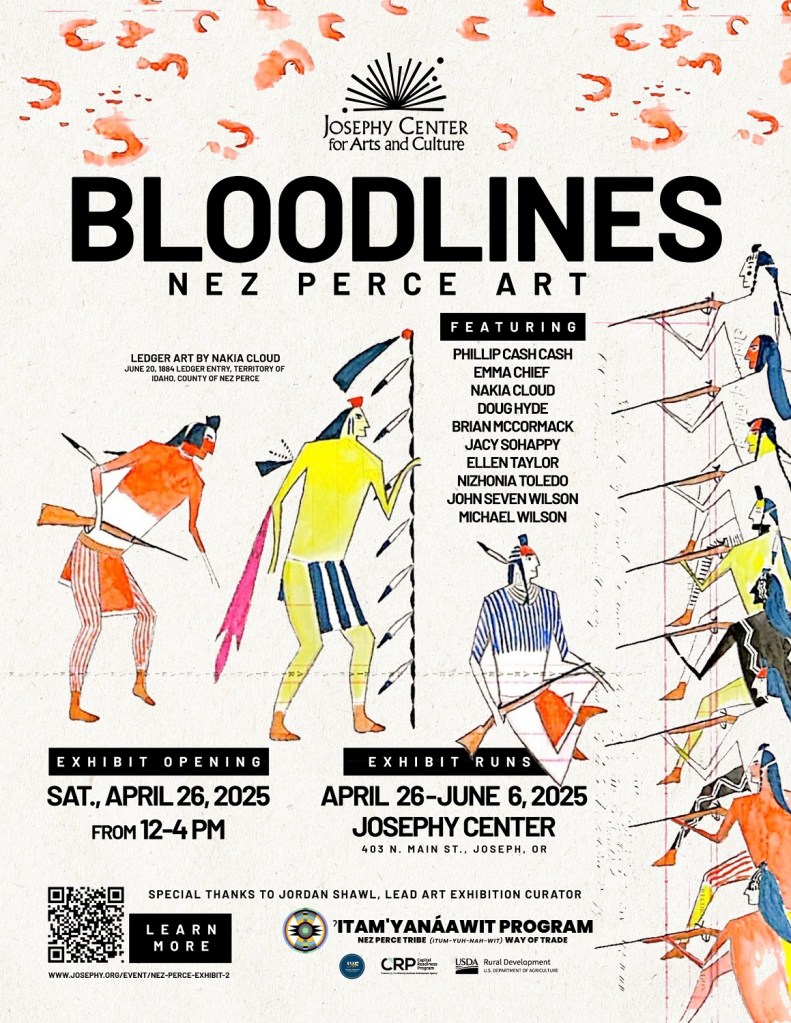
I recently attended an art show in Joseph, Oregon at the Josephy Center for Arts and Culture. The show was Bloodlines: Nez Perce Art Exhibit.
There was traditional weaving, sewing, beading, painting, and bronze work, all created by twelve Nez Perce artists. The variety of mediums were a good representation of not only cultural traditions, such as the beading and weaving, but to see history translated into art and current themes.
The show opened at noon on Saturday with a prayer and a song by artist Nakia Cloud. It was fun to see and listen to him and then study his “Art on a Ledger.” He’d drawn more traditional-looking subjects on used ledger paper.
Jacy Sohappy had traditional patterns in her weaving and had an elk tooth dress on display.
The youngest artist represented was Emma Chief a teenager. I listened in as she explained two of her paintings to other art enthusiasts at the show. She held a deep understanding of her culture and had paintings that reflected the strength of women.
She wasn’t the only one who had women’s strength portrayed. Ellen Taylor had some striking paintings of women and one of Prince, the singer, as a Native American and Marilyn Monroe as a Native American. I have to admit I was tempted to purchase one of her prints of a Native American woman. The colors and the woman’s strength drew me.
Center stage of the whole event was Doug Hyde’s bronze of a Nez Perce woman warrior. It was striking and showed the strength and resilience of women.
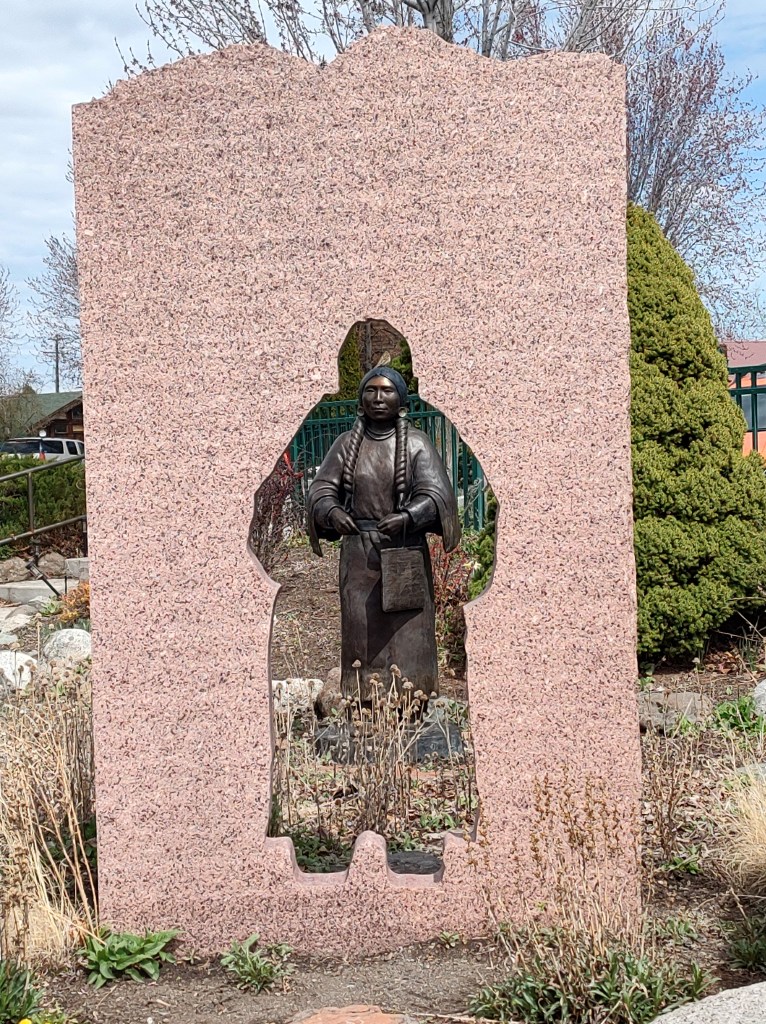
Doug also has a large bronze int he front of the building. It deals with the return of the Nimiipuu (Nez Perce) to Wallowa County. After the treaty of 1863, when the government reduced the size of the reservation taking away the walwa’ma band (Chief Joseph’s band) homeland given to the Nez Perce in the Treaty of 1855, Young Chief Joseph was moving his people to the Lapwai reservation when an altercation happened. The altercation set them and some other bands headed to Canada.
Many have heard of Chief Joseph’s surrender at Bearpaw Montana. But did you know that after they surrendered and were told they would return to Oregon, they were exiled to Kansas and Indian Territory? Many died from the heat and conditions. In 1885 they were finally allowed to return to the West, but not to Wallowa Valley. About half of them were sent to the Colville Reservation in Washington state, and the other half went to the Lapwai Reservation.
Many of the walwa’ma band remain at the Colville Reservation while others are spread among the Lapwai and Umatilla Reservations in Idaho and Oregon.
It wasn’t until the late 1970’s that other than participating in the Chief Joseph Day’s rodeo and parade that the Nez Perce were allowed back into Wallowa County. Now they have an interpretive center, powow grounds, a Wallowa Homelands, and more representation on the streets of Joseph with sculptures and they have an Nez Perce fisheries in the county.
Back to Doug Hyde’s bronze in the front of the Josephy center, which is named for a man who befriended the Nez Perce and wrote books showing their culture and language. The artwork titled: ‘etweyé-wise means The Return or specifically “I return from a hard journey.” It is the photo at the beginning of this piece.
Unfortunately, I was so busy looking at the artwork I didn’t take a photo of any of it. You can see some of the works at the website in the beginning of the post.
 Writing Into The Sunset