Indigenous Peoples Day

As a writer of Native American characters in my books, and not being Native American, I keep abreast of all the ways Indigenous people are being heard and seen. In fact, that is the main reason for my three mystery series. I started the Shandra Higheagle Mystery series with the desire to write about a culture I have been in awe with my whole life. And have felt have been unjustly treated.

My mystery books are not only written with a twisty mystery, but I also deliver a small amount of Indigenous culture and what they deal with from people who don’t care to understand their culture. Shandra Higheagle had a Nez Perce father and a White mother. I had her raised in the white world and brought her back to her Nez Perce family as an adult. Having her learn about her culture as I did.

My Gabriel Hawke books, I have a character with a Nez Perce Father and a Cayuse/Umatilla mother. He grew up on the Confederated Tribes of the Umatilla reservation but went straight into the Marines from high school and from there straight into the Oregon State Police, living off the reservation. He as he is aging and seeing an end to his career as a trooper is returning to his culture. Which again, allows me to learn more and bring it to my readers through his eyes and emotion.

The third series, Spotted Pony Casino, is set on the Umatilla Reservation in a fictional casino. My main character grew up on the reservation but with a White mother and she believed a Hispanic father. While she was around the culture, they didn’t embrace it in their home. Once again, I can show the reservation life and the culture through this character’s eyes and the secondary characters in her life. For this series I also subscribe to the reservation newspaper as well as I have contacts that I use to help me keep the lifestyle and culture as accurate as I can while not living there or being of the culture.

Today is a day where we recognize and appreciate the Indigenous People of this continent. But it shouldn’t happen on one day. It should be something that is honored and recognized every day. Their beliefs in nature and how they are trying to preserve it along with their family values are something many of us have lost.

I hope you read a book or watch a movie with Native American characters or discuss this day and keep learning about their cultures today.

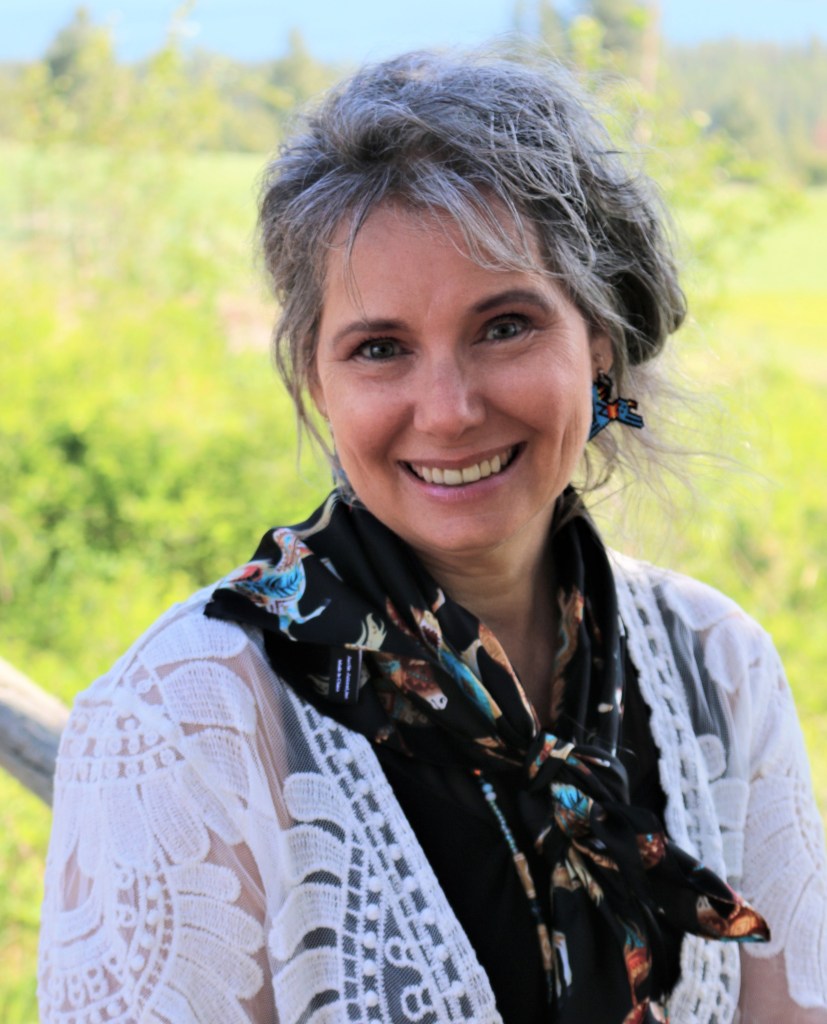
Special Guest and Friend, Carmen Peone

Carmen Peone’s series Seven Tines Ranch are sweet contemporary romance books that deal with abusive relationships. I’m happy to share my blog space with her and her books and hope they help women in similar situations.

Cowgirls with Grit

You gotta love cowgirls with grit.

They are hardworking, super businesswomen, dedicated, and beautiful – inside and out.

You might hear one saying something like:

A woman who wears spurs gets the job done.

Dwellin’ on lost love leaves no room for future romance.

Ridin’ the gossip wagon is not group therapy.

You might see one of them:

Carrying a flag, turning a can, wearing a crown, or roping a calf.

You might even find one, like my heroine, Rita Runninghorse, roping several calves, giving them shots, tending to bovine and equine wounds and illness, fixing fence, herding cattle, and baking her favorite dessert.

Check out the opening scene of my latest novel, Broken Bondage.

 Early October

Umatilla Indian Reservation, Eastern Oregon

“You dirty bugger, git over here!” Henry, the red-and-white

calf Rita Runninghorse had secretly named,

darted sideways as she winced at the pain in her sides,

gathered her lariat, and tried for another loop.

Her head pounded from when her fiancé, Bowie Dark

Cloud, had slammed her against the door of his pickup

earlier that morning and crushed her against a stall door two

days ago.

Concentration eluded her, and her timing dragged

like the sludge of cold cowboy coffee at day’s end. Dusk’s

chilly breath hovering over the rolling hills of the Columbia

Plateau country on her father’s ranch failed to help matters.

“Come on, Opal, let’s get ’im this time.” She swung her

lasso overhead and spurred her smokey grulla mare into a

gallop, close on the calf ’s tail. With her horse staying on him,

she landed the loop over its head and reined her mare to the

right. Th e jerk of the rope when her horse skidded to a halt

caught her breath.

The calf balked on the other end of the rope as Rita jumped

off, and her backside landed on the wet ground. Could this

day get any worse? She pushed to her feet, wobbled toward

the wide-eyed little one, and flopped him to the ground with

a deep groan. Good grief. Her father could’ve built a smaller

holding pen.

“Sorry, little man,” she said, thankful for the fall calf ’s

small size. “You shouldn’t have run from me.”

Rita pulled a short piggin’ string from her back pocket

and tied the critter’s legs together. Seconds later, he finally

quit fighting her. Th e cut on his leg was nastier than she’d

suspected. She went to one of her saddlebags and retrieved a

syringe and a bottle of penicillin. His round eyes watched her

while she cleaned the crusty wound, a low bellow escaping

his mouth.

Inhaling his earthy scent, she gave him a shot of antibiotic,

massaged the injection site, and untied his legs. “All better

now.”

Carmen’s Latest Book

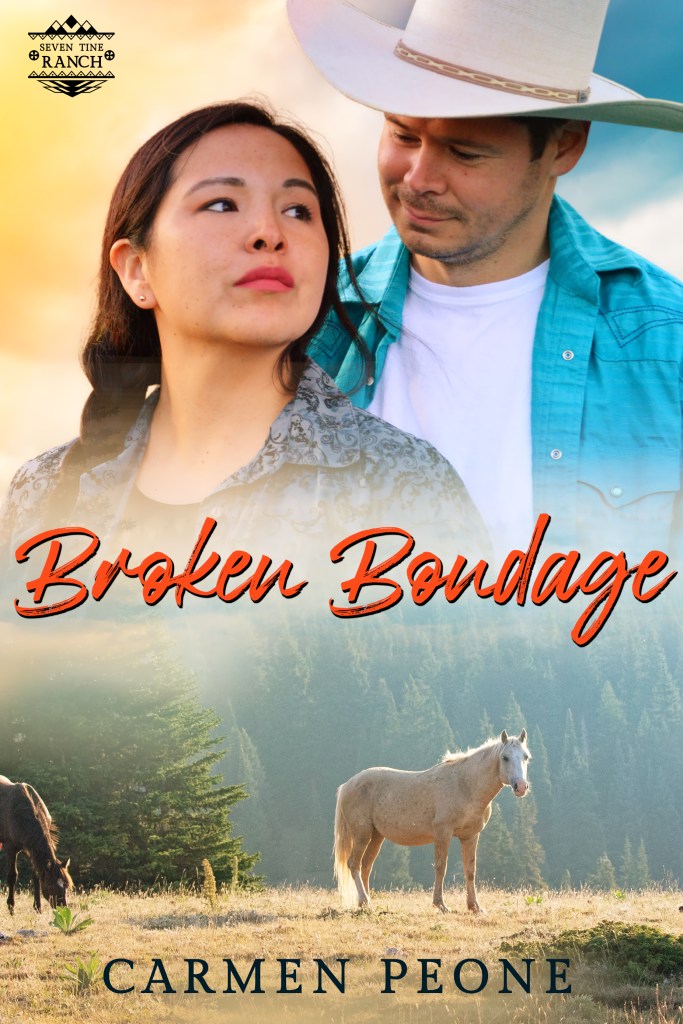
Broken Bondage

A Road Trip to Redemption

Rita Runninghorse is about to marry the wrong guy. She has to get away from him. Now. She flees to a guest ranch in Eastern Washington State that offers a safe haven for women in need only to find the owner on a month-long speaking tour.

Robert Elliot has one thing on his mind: bronc riding. The Indian National Finals Rodeo is within reach, and he’s not about to let anything ruin his chances of going pro. Not even the woman he finds asleep in the stall of their rankest horse. 

When Rita’s fiancé discovers where she’s hiding out, she takes Robert’s offer to go with him on the road and prays her fiancé gives up the hunt. Saddled together, Rita and Robert must rely on each other as they go on the road to keep her alive.

Grab your copy now!

About Carmen

Carmen Peone is an award-winning author of Young Adult and Inspirational Western Romantic Suspense and lives with her husband in Northeast Washington and on the Colville Confederated Indian Reservation. With the love of history and the Western woman’s lifestyle, she weaves threads of healing, hope, and horses, with threads of love, of course, into her stories.

Connect with Carmen

Website and Blog | Facebook | Twitter | Instagram | Pinterest | BookBub | Goodreads

Sign up for her newsletter and receive her novella, Gentling the Cowboy for Free. https://bit.ly/3WyltBG

The End of Summer

As we come to the end of summer and September, I feel like we dashed over summer and fall isn’t going to get much time to change leaves and enjoy the warm afternoons. The last few days here have felt more like winter is sneaking in fast.

Does it feel like that where you are?

Going on my morning walks this week, I’ve had to wear my head warmer headbands, a warm sweatshirt and gloves. Just the week before I was in a t-shirt and cap. Poor Nia doesn’t like the change of weather either. She doesn’t have a lot of hair to keep her warm. Though just like a kid, if she’s outside playing, she doesn’t seem to mind the cold and wet.

I feel bad I haven’t ridden my horse all summer. At the beginning of summer, his old body wasn’t looking very good. I kept him on full feed and he is looking much better now. A granddaughter used him for Horse 4-H but that’s all the riding he’s had. Every morning I tell him, “Tomorrow we’ll ride.” Then something comes up that I feel I need to take care of and I neglect my horse and my me time. Possibly Sunday, I can ride. Hubby will be home. He doesn’t like me riding when he isn’t here.

With the end of summer, I only have two more book/writing events left for the year. The first week of November I’ll be in Las Vegas at the Horeshoe Casino for an author promotion and marketing conference. I really have to get the word out about my audiobooks. On the last day of the conference is a RAVE (Reader Author Vegas Event). I’ll be selling some of my books that day along with 300 other authors. If you live in the area or are passing through on November 10th, let me know if you need a specific book and I’ll have it there. I’ll be reading from Murder of Ravens at 11:10 am at the RAVE event.

Then three days after I get home from that, I’ll be headed to Portland and the Portland Holiday Market at the Expo Center. I’ll be working in NIWA’s traveling book booth. I’ll have book bundles for sale there.

After that my year ends quietly. I can do with some slow, quiet time.

Right now I’m working on a Christmas novella. I hope to have it published the first of November. We’ll see!

I hope you are all staying warm and looking forward to the rest of 2023.

Southernmost tip of the U.S.

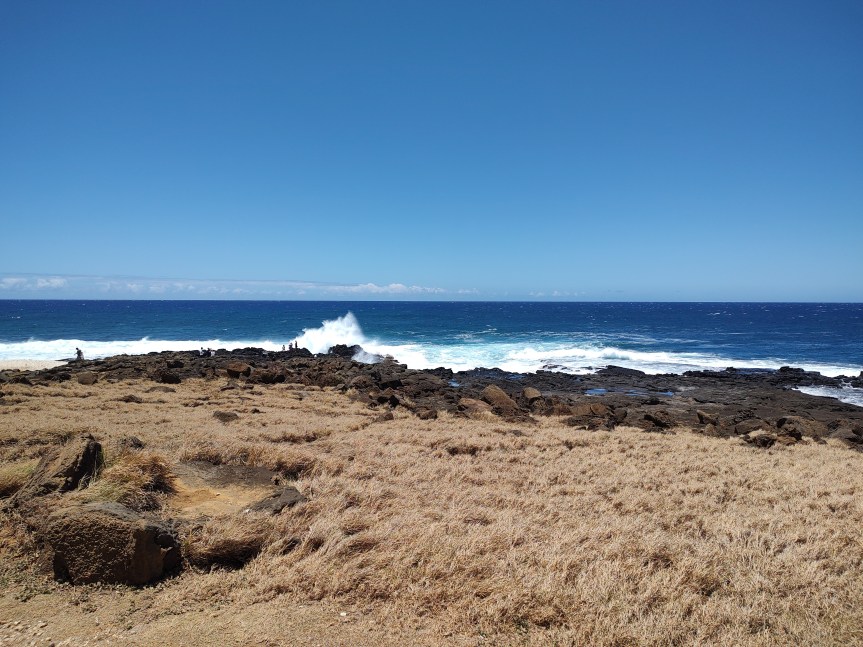
I can now say I have been the farthest south you can go in the United States. On my trip to the Big Island of Hawaii my friend and I went to the southernmost tip of the island. We were told about this spot by a local when we asked her what places we should see.

One morning we got up, had breakfast and packed a cooler with water and snacks and headed south on the Hawaii Belt Road or Mamalahoa Hwy. When we came to the Point Road, we turned down that and found a dirt area at the end of the road where cars were parked and there were porta-pottys and a snow cone vendor.

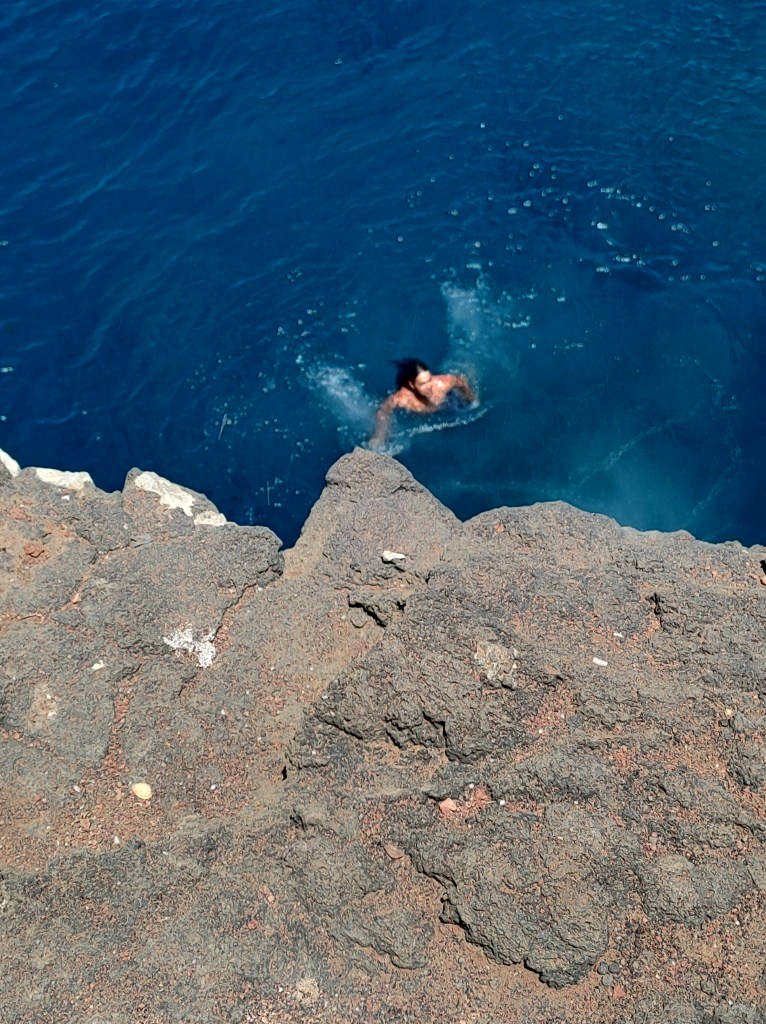
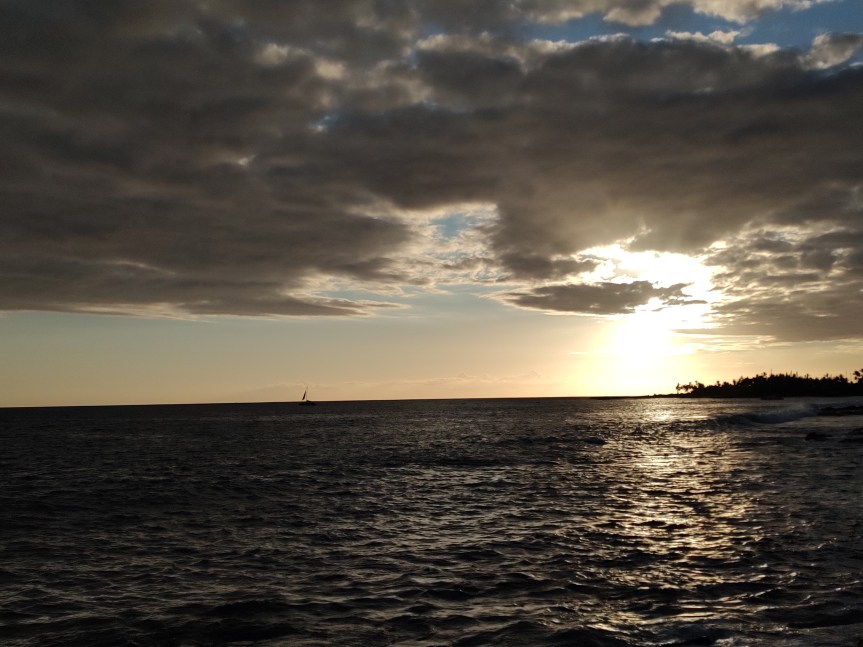
We walked over to the forty-foot cliff edge and peered down into the beautiful crystal-clear water. I loved the colors and energy of the sparkling ocean.

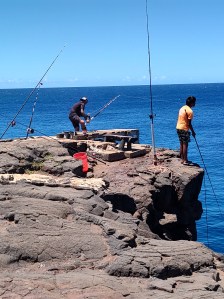
A man had just jumped in. I took a photo of him. He looked like a native swimming in the water. And come to find out, my friend started talking to the man’s wife. He was from the island and they were visiting from Seattle. She also dove into the water with him down below to help her swim around the point to climb up the rocks. There was a ladder down the side of the cliff, but she was too short to reach the rope that would get her to the ladder.

Another one of their friends jumped. I snapped a photo of him jumping.

There were also to boys fishing from a hole in the lava that was back about 60 feet from the ocean. The hole looked like it went down forty feet to water that washed in and out with the tide.

A young man and a boy were fishing off the edge of the cliff as well. The boy made my friend nervous. He would stand right on the edge as he cast his pole. They had large black garbage bags tied to their lines to pull the hooks out farther into the ocean. They were trying to catch ahi, tuna.

After hanging around there a while, we followed a trail that took us to the southernmost point. It was a beach made up of dead coral. It was sad to see so much bleached coral broken in pieces.

We didn’t take the hike or the drive around to the green sand beach.

Leaving that area, we ended up at Punuluu Bakery also a place the local woman told us to enjoy. We did enjoy the pastries and the lunch we bought there.

And that wraps up another day we enjoyed in Hawaii.

Book Happenings

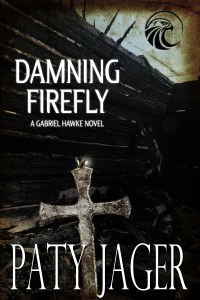
My latest Gabriel Hawke book, Damning Firefly, will be releasing the end of this month. If you don’t want to miss purchasing it, you can pre-order it in ebook format.

Book 11 in the Gabriel Hawke Series

A church fire.

An unconscious woman on Starvation Ridge.

Gabriel Hawke, fish and wildlife officer with the Oregon State Police, helps with a fire at the Lighted Path church before heading out to check turkey hunters. He discovers a car wedged between two trees and a woman with a head injury reeking of smoke. Is she the arsonist?

Hawke encounters the county midwife gloating over the burnt church and learns she and the victim in the car know one another.

Two seemingly separate events lead Hawke to a serial rapist and a county full of secrets. 

Universal link to pre-order: https://books2read.com/u/bQeBDZ

Hulihe’e Palace

One morning we decided to walk farther north than we had previously. We found more shops, restaurants and a resort. But the fun thing we came across was a summer home of the Hawaii’s royalty.

It was complete in 1938 and became the personal residence of John Adams Kuakini the Governor of the island of Hawaii. It was built by foreign seamen and missionaries. They used resources on the island such as lava rock, coral lime mortar, koa and ohi’a woods.

Walking around inside the structure I mentioned to my friend the walls were really thick. Three feet says the pamphlet. I thought maybe two, by width of the windowsills. It is a beautiful building with tall ceilings and massive furniture. There are two floors come in at 3600 sq feet. there was also a basement with 2 cisterns. The cook house could be accessed through the dining room. There were also other small bungalows on the property when royalty lived there.

The last royal to own the property was an adopted heir of Queen Kapi’olani. the next owner was Mrs. Allen who died a month after purchasing the palace. The home remained vacant for 10 years.

In 1925 the building was purchased by the Daughters of Hawai’i to keep it from becoming hotel development. That is who operates and attends to it as a museum.

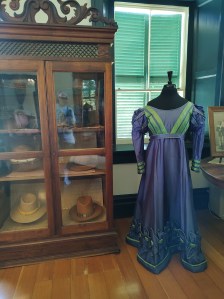
There are many items in the house that were purchased or given to the royals. What fascinated me were the long sticks with different shaped, what looked like lamp shades covered with feathers. Because my curiosity was aroused, I asked the woman docent who was there what they were. Feathers were treasured. with all the brightly plumed birds on the islands, the colorful feathers were deemed fit for royalty. Many photos you see that depict the leaders/royalty of Hawaii, they are wearing capes that are covered with feathers.

These feathered “lamp shades” on sticks were carried in front of Royalty when they walked around outside their homes. It was how they were recognized when travelling about the islands.

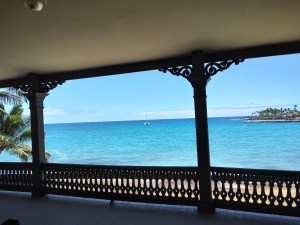
The lanai of the home has breathtaking views of the ocean across Kailua Bay.

BOOK HAPPENINGS

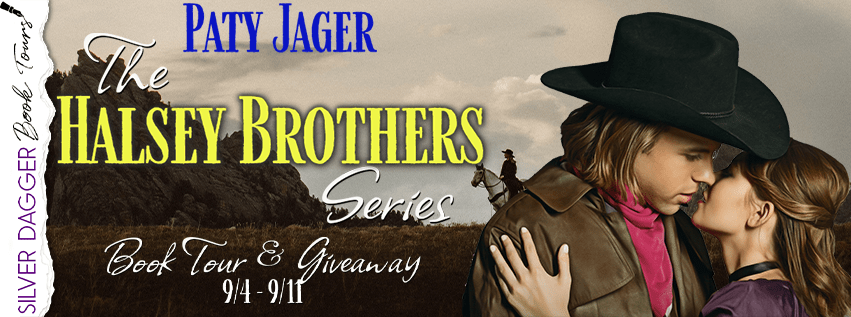
Starting this week, you can follow the Silver Dagger Book Tour for my new -Cover reveal for the Halsey Brother Series/ Halsey Homecoming tour. There are prizes awarded for following and adding your name to the raffle.

https://www.silverdaggertours.com/sdsxx-tours/the-halsey-brothers-series-book-tour-and-giveaway

Hiking the Edge of a Crater

Our next stop was the Kilauea Visitor Center for the Kaluapele volcano caldera. Here we entered the park and strolled through the visitor center learning about the Kilauea Caldera which is an active shield volcano. Meaning it is a low-profile volcano looking like a warrior’s shield sitting on the ground. It is formed by highly fluid lava. Steady eruptions are what make the dome like volcano due to the slow of the fluid lava.

After leaving the visitor center we drove to a trail that went along the edge of the caldera. There were a lot of different foliage, and we struck up conversations with people from the states as well as other countries. The trail was dirt with lots of roots sticking up to catch a toe on.

We also saw a couple of cracks in lava tubes that ran under the path where we walked.

Looking down into the caldera we could see people walking across the crusty floor of the crater.

See the trail where people hike?

We thought we were going to get to a lava tunnel, but we came to another parking lot and thought maybe we missed the tunnel. We turned around and walked back only to discover we hadn’t missed it. We drove on and found the parking lot that we’d walked to and found the tunnel across the parking. Only there were so many cars there we couldn’t find a place to park to explore the tunnel. So fair warning, when you get to the end of the path from the first parking lot, cross the second parking lot and you will find the tunnel.

I love happenstance.

While my friend and I were vacationing on the Big Island of Hawaii, we’d set a course each day for one place and then stop along the way when we came across something that intrigued us.

That’s how we came across a pretty park with history on the southeast shore of Hawaii. We were headed to Volcano Park when we saw what looked like the remnants of a pier from the highway and a sign that said Whittington Beach State Park. I pulled down into the park and we looked around.

We found two “ponds” of water that came from the ocean but were caught in what looked like ponds. They made good swimming for the people at the park. There was also a woman fishing from the lava along the shoreline and a man taking shade in one of the covered spaces to picnic.

Following our curiosity, we headed toward the poles sticking up out of the water with a few boards still attached. there was also a rock and concrete wall sticking up in a small inlet behind the pier. We wondered if it had once been a navy site during WWII or what. After taking photos and discussing it we headed on to the volcano park.

On our return to where we were staying, we pulled out our computers and started googling Whittington Beach State Park.

The park is located on Honuapo Bay which means Turtle Cove Bay. It is home to the Green Hawaiian Sea Turtle. The park was named for Richard Henry Whittington in 1948.

The first pier constructed in this bay was in the early 1800s. When the Europeans arrived, it was already a thriving fishing village. A drought in the 1840s hurt the economy and in 1868 a hurricane and tsunami wiped out the pier. By 1880, the pier was once again active with shipping island crops via train to the port and fishing. By 1930 the port supported a large sugar cane plantation.

But the remnants you see today happened after the bombing of Pearl Harbor. The U.S. military fearing Japan would see the pier as a way to gain footing in the islands bombed by pier, leaving what you see today.

That was just one of the wonderful things we learned this trip.

A Hawaiian Gift

August, I was gifted with a trip to the Big Island of Hawaii. A person my hubby has helped out a lot offered us the use of their condo in Kona. Unfortunately, the time of year didn’t work well for my hubby. It was the middle of haying season. However, he told me to go and take a friend. He didn’t have to suggest it twice. 😉

We arrived in Kona on August 8th and August 9th we discovered a small coffee plantation and roasting operation. The Kona Le’a Plantation is on the Mamalahoa Highway. We were just out checking the area and my friend spotted the sign for the plantation. While I’m not a coffee drinker, she is.

I learned a lot about a coffee bean, how they are roasted at this operation, and my friend sampled the coffees. She preferred the air roasted coffee to the fire roasted. We were told it would have a smoother less weighty taste and she confirmed it.

She also explained a pea berry. It is the full bean, both halves still firmly connected. When the halves of the bean stay together, they have more oil and more flavor. When a bean is dried and it falls into two pieces, it is drier and will crack in the roasting process. A whole bean stays together during the roasting and holds in the oils, only roasting out the moisture. It is a premium bean.

Air Roaster
Fire roaster

The air roaster is a faster way to roast, cools faster, and gives a smoother taste, it is also easier to set and get the quality of roasting than the fire roaster which can burn the beans if a close eye isn’t kept on the temperature. Also, the fire roaster doesn’t cool down as fast and can end up giving the beans a burnt taste. The longer, darker roast has less caffeine than the shorter roasting time which is the lighter roast.

Coffee Plant

The Kona Le’a Plantation is also all organic. Coffee cherry skins and husks are composted and put back in the ground to give future crops nutrition. Green waste is trucked in and used at mulch and weed control.

Coffee beans. Need to be maroon or deep red before being picked.

The beans are hand harvested. They also roast beans for other small coffee farmers.

While we were there, we were treated to a tasting of not only coffee, but also honey, Hawaii fruit paste, and chocolate covered pea berries. I liked the honey and the fruit paste, but even though the roaster said the wonderful chocolate would temper the pea berry, I tasted more coffee than chocolate.

While I am not a coffee drinker, I can appreciate all the work that goes into making the coffee so any people do drink.

Tamkaliks Ceremony

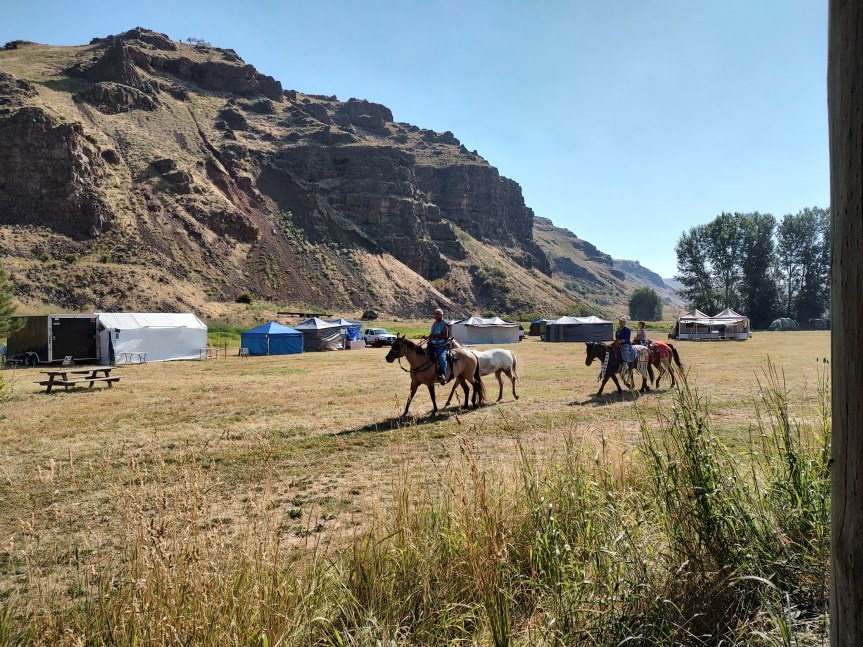
The third week of July, I attended the Tamkaliks Ceremony held in Wallowa, Oregon. My brother, sister-in-law, and I arrived Saturday morning before the horse procession. This is where members of tribes who once lived in Wallowa County ride horses around the dance arbor. A riderless horse is led by one of the riders. This symbolizes the ancestors who have passed and any tribal members who were lost the past year. They ride slowly around the arbor, and begin singing, until they finally dismount and enter the arbor.

Every time I witness this procession it makes me emotional. The reason I write the characters I do, is to show the world how the Native Americans revered the land that gave them life and how resilient they are to be proving they are the stronger people.

That morning we joined in the Friendship dance and watched the naming ceremony, passing of the pipe ceremony, and gift giving ceremonies from the families of members who had passed since the last Tamkaliks celebration. The princesses who were at the celebration ranged in age from 6 to teens. I enjoyed hearing each of them tell us about themselves in their language and then repeat it in English. I love that the young people are learning more and more about their culture that had been stolen from the grandparents and great grandparents.

Around noon we headed to the Wallowa Historical center to look up information I wanted for the current work in progress. Then we had to go to the Josephy Center in Joseph for my brother to pick up his artwork and that of his daughter and wife that had been on display.

That evening we went back to Wallowa and watched them honor the veterans and the contest dancing. The beautiful regalia was breathtaking. The young men put on a show, with their bobbing, stomping, and twirls. The women’s dresses and shawls were colorful. Many dresses were made of the beautifully tanned deer and elk hide adorned with shells and elk teeth.

A wonderful thing happened that I had hoped for when I decided to go Tamkaliks. That was meeting someone who would guide me with my Native American characters. While sitting and watching the ceremonies in the morning, there was a woman below us who answered questions and taught a young couple how to say her dog’s Nez Perce name. I felt she was so willing to teach non-Indian people her culture she might be a good person to ask about helping me. When I finally got up the nerve to talk to her, she was open and willing to work with me. She said her new job was working with people like me to understand the Nez Perce culture. I gave her my card and she gave me her name, email address, and phone number. I’m excited to start working with her.

It was a wonderful weekend, gathering information for my books and immersing myself in another culture.

Flat Tire and Inspiration

Over the past weekend I drove to Wallowa County on a research trip. Those that read this blog and my books, know that my Gabriel Hawke series is mostly set in the county. I had two, well, three reasons to go to the county.

Reason one was to attend the Tamkaliks Ceremony. It is a powwow held every July in Wallowa, Oregon. And while I did attend and came up with some ideas to add to my books as well as made a great contact, this post isn’t about the powwow. That will be the next post. 😉

Reason two, the current work in progress (WIP) has a couple of scenes set in an area I have never seen in person. I’ve heard stories and looked it up on Google Earth and an Oregon Atlas & Gazetteer. I had this feeling I needed to see the area.

Reason three, I couldn’t find anywhere to tell me why the area was named the way it was.

I left Thursday, spent the afternoon and night with our oldest daughter in Cove, OR and wandered on to Wallowa County Friday morning. In the county there is an old town named Maxville. There had been a lot more talk about it the last few years. They have an interpretive center for the town in Joseph and even had a day when you could take a tour of the area. I had a prior commitment and couldn’t make it. So I decided to take a look on my own on the way to my brother’s in Enterprise.

I turned at the sign on the highway that said Maxville 13 Miles. Then I turned on my phone’s GPS knowing I was headed onto dirt roads that wove through timber. My phone told me I had arrived when there was a long drop in a wooded canyon to my right and a steep hill on my left. I didn’t see anything that remotely looked like old buildings or a logging camp. I went farther and discovered a road that went off through the woods with a sign that said no motorized vehicles.

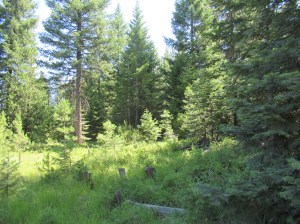
Nia and I got out and walked up the road a bit, but didn’t see anything other than a deer, a squirrel, trees, wildflowers and bushes. We returned to the car and turned around. What I was searching for was a logging camp that was set up in the woods in 1923 by a logging company out of Missouri. They brought Black loggers and families to the county to work at the camp. The unincorporated town lasted about ten years and the families slowly moved away as the logging died out. My curiosity about history had me wanting to see what was left of the town. But I didn’t find it.

We made it back to the highway and my brother’s house. There I told my sister-in-law about wanting to learn the reason behind the name Starvation Ridge and take a drive out to see it. We first went to the Wallowa County Historical Center in Joseph to see if we could learn anything about the naming. No one there could help us. As we left there my brother called and said he was off work what were we up to.

We told him of my desire to go to Starvation Ridge, so we swung by the house and picked him up. We had a good discussion about the name on the way out and I was glad I’d decided to see the ridge in person. It wasn’t what I’d expected from the shots on Google Earth. The road was made of fist-sized and large jagged rocks which made driving a slow process. And the area I thought I knew from the satellite images didn’t look the same from ground level. It helped me better understand the lay of the land. Which in turn meant changing a couple of scenes in my WIP.

This is where the flat tire comes in. I turned around and immediately one of my tires lost twenty pounds of air pressure. We crept to a spot where there were fewer nasty rocks and in the shade. My brother changed the tire with my SIL and I helping. We made it back to the tire store before they closed and had the tired fixed and put back on.

The next day while we were attending the Tamkaliks Celebration, we ran into a person who knows a lot of Wallowa County history. He couldn’t tell us what we wanted to know but he suggested we try the Wallowa Historical Center. And we found our answer in a thick book. I wanted to know how Starvation Ridge got its name. It wasn’t near as interesting as the stories my brother and his wife thought were the reasons. It was named that by Billy Smith who left his sheep on the ridge so long they ate all the grass off of it one year.

And that was the essence of my research trip. My next blog will be about the Tamkaliks Ceremony.

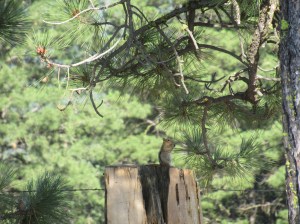
I’ll leave you with a photo I took of a chipmunk.