Southernmost tip of the U.S.

I can now say I have been the farthest south you can go in the United States. On my trip to the Big Island of Hawaii my friend and I went to the southernmost tip of the island. We were told about this spot by a local when we asked her what places we should see.

One morning we got up, had breakfast and packed a cooler with water and snacks and headed south on the Hawaii Belt Road or Mamalahoa Hwy. When we came to the Point Road, we turned down that and found a dirt area at the end of the road where cars were parked and there were porta-pottys and a snow cone vendor.

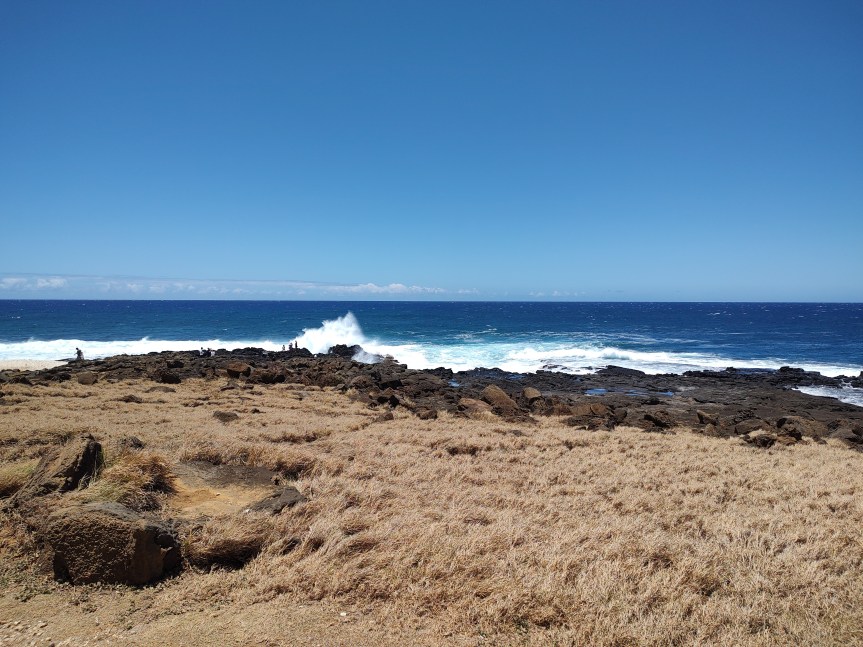
We walked over to the forty-foot cliff edge and peered down into the beautiful crystal-clear water. I loved the colors and energy of the sparkling ocean.
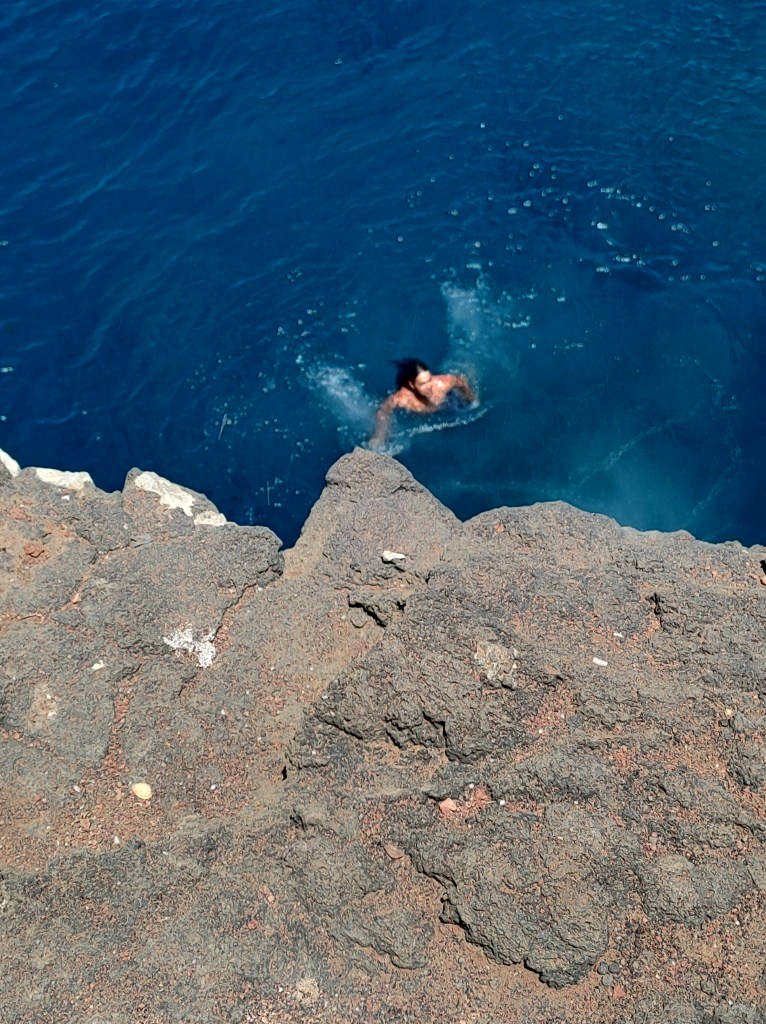
A man had just jumped in. I took a photo of him. He looked like a native swimming in the water. And come to find out, my friend started talking to the man’s wife. He was from the island and they were visiting from Seattle. She also dove into the water with him down below to help her swim around the point to climb up the rocks. There was a ladder down the side of the cliff, but she was too short to reach the rope that would get her to the ladder.

Another one of their friends jumped. I snapped a photo of him jumping.

There were also to boys fishing from a hole in the lava that was back about 60 feet from the ocean. The hole looked like it went down forty feet to water that washed in and out with the tide.

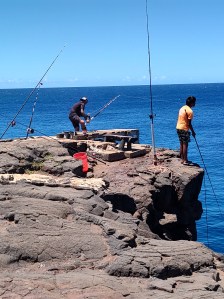
A young man and a boy were fishing off the edge of the cliff as well. The boy made my friend nervous. He would stand right on the edge as he cast his pole. They had large black garbage bags tied to their lines to pull the hooks out farther into the ocean. They were trying to catch ahi, tuna.
After hanging around there a while, we followed a trail that took us to the southernmost point. It was a beach made up of dead coral. It was sad to see so much bleached coral broken in pieces.

We didn’t take the hike or the drive around to the green sand beach.

Leaving that area, we ended up at Punuluu Bakery also a place the local woman told us to enjoy. We did enjoy the pastries and the lunch we bought there.

And that wraps up another day we enjoyed in Hawaii.

Book Happenings

My latest Gabriel Hawke book, Damning Firefly, will be releasing the end of this month. If you don’t want to miss purchasing it, you can pre-order it in ebook format.

Book 11 in the Gabriel Hawke Series

A church fire.

An unconscious woman on Starvation Ridge.

Gabriel Hawke, fish and wildlife officer with the Oregon State Police, helps with a fire at the Lighted Path church before heading out to check turkey hunters. He discovers a car wedged between two trees and a woman with a head injury reeking of smoke. Is she the arsonist?

Hawke encounters the county midwife gloating over the burnt church and learns she and the victim in the car know one another.

Two seemingly separate events lead Hawke to a serial rapist and a county full of secrets. 

Universal link to pre-order: https://books2read.com/u/bQeBDZ
Hulihe’e Palace

One morning we decided to walk farther north than we had previously. We found more shops, restaurants and a resort. But the fun thing we came across was a summer home of the Hawaii’s royalty.

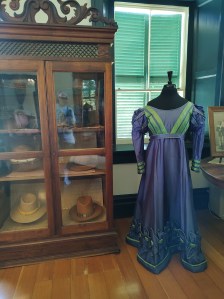
It was complete in 1938 and became the personal residence of John Adams Kuakini the Governor of the island of Hawaii. It was built by foreign seamen and missionaries. They used resources on the island such as lava rock, coral lime mortar, koa and ohi’a woods.

Walking around inside the structure I mentioned to my friend the walls were really thick. Three feet says the pamphlet. I thought maybe two, by width of the windowsills. It is a beautiful building with tall ceilings and massive furniture. There are two floors come in at 3600 sq feet. there was also a basement with 2 cisterns. The cook house could be accessed through the dining room. There were also other small bungalows on the property when royalty lived there.

The last royal to own the property was an adopted heir of Queen Kapi’olani. the next owner was Mrs. Allen who died a month after purchasing the palace. The home remained vacant for 10 years.

In 1925 the building was purchased by the Daughters of Hawai’i to keep it from becoming hotel development. That is who operates and attends to it as a museum.

There are many items in the house that were purchased or given to the royals. What fascinated me were the long sticks with different shaped, what looked like lamp shades covered with feathers. Because my curiosity was aroused, I asked the woman docent who was there what they were. Feathers were treasured. with all the brightly plumed birds on the islands, the colorful feathers were deemed fit for royalty. Many photos you see that depict the leaders/royalty of Hawaii, they are wearing capes that are covered with feathers.

These feathered “lamp shades” on sticks were carried in front of Royalty when they walked around outside their homes. It was how they were recognized when travelling about the islands.

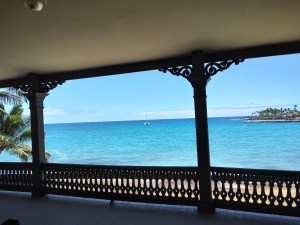
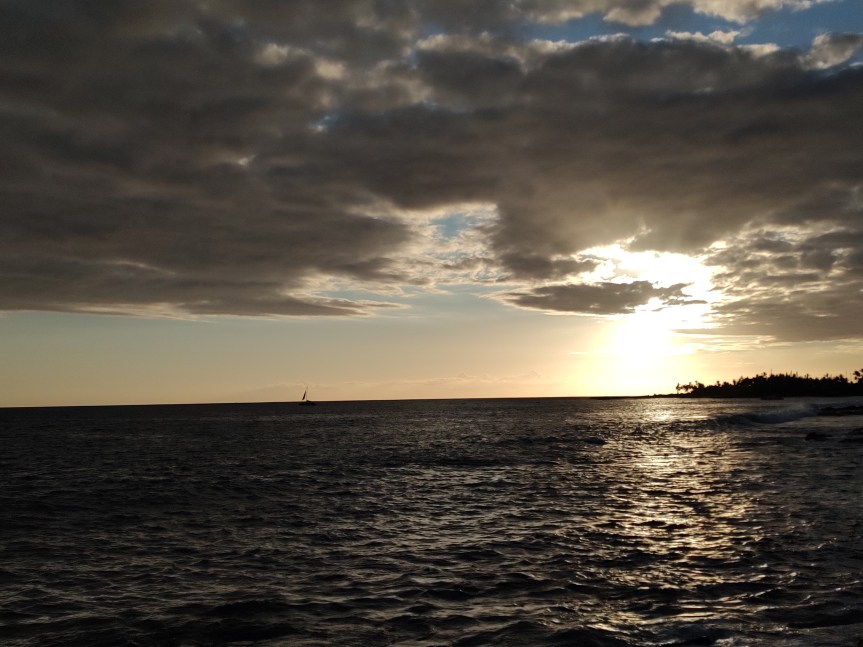
The lanai of the home has breathtaking views of the ocean across Kailua Bay.

BOOK HAPPENINGS

Starting this week, you can follow the Silver Dagger Book Tour for my new -Cover reveal for the Halsey Brother Series/ Halsey Homecoming tour. There are prizes awarded for following and adding your name to the raffle.

https://www.silverdaggertours.com/sdsxx-tours/the-halsey-brothers-series-book-tour-and-giveaway

Hiking the Edge of a Crater

Our next stop was the Kilauea Visitor Center for the Kaluapele volcano caldera. Here we entered the park and strolled through the visitor center learning about the Kilauea Caldera which is an active shield volcano. Meaning it is a low-profile volcano looking like a warrior’s shield sitting on the ground. It is formed by highly fluid lava. Steady eruptions are what make the dome like volcano due to the slow of the fluid lava.

After leaving the visitor center we drove to a trail that went along the edge of the caldera. There were a lot of different foliage, and we struck up conversations with people from the states as well as other countries. The trail was dirt with lots of roots sticking up to catch a toe on.

We also saw a couple of cracks in lava tubes that ran under the path where we walked.

Looking down into the caldera we could see people walking across the crusty floor of the crater.

See the trail where people hike?

We thought we were going to get to a lava tunnel, but we came to another parking lot and thought maybe we missed the tunnel. We turned around and walked back only to discover we hadn’t missed it. We drove on and found the parking lot that we’d walked to and found the tunnel across the parking. Only there were so many cars there we couldn’t find a place to park to explore the tunnel. So fair warning, when you get to the end of the path from the first parking lot, cross the second parking lot and you will find the tunnel.

I love happenstance.

While my friend and I were vacationing on the Big Island of Hawaii, we’d set a course each day for one place and then stop along the way when we came across something that intrigued us.

That’s how we came across a pretty park with history on the southeast shore of Hawaii. We were headed to Volcano Park when we saw what looked like the remnants of a pier from the highway and a sign that said Whittington Beach State Park. I pulled down into the park and we looked around.

We found two “ponds” of water that came from the ocean but were caught in what looked like ponds. They made good swimming for the people at the park. There was also a woman fishing from the lava along the shoreline and a man taking shade in one of the covered spaces to picnic.

Following our curiosity, we headed toward the poles sticking up out of the water with a few boards still attached. there was also a rock and concrete wall sticking up in a small inlet behind the pier. We wondered if it had once been a navy site during WWII or what. After taking photos and discussing it we headed on to the volcano park.

On our return to where we were staying, we pulled out our computers and started googling Whittington Beach State Park.

The park is located on Honuapo Bay which means Turtle Cove Bay. It is home to the Green Hawaiian Sea Turtle. The park was named for Richard Henry Whittington in 1948.

The first pier constructed in this bay was in the early 1800s. When the Europeans arrived, it was already a thriving fishing village. A drought in the 1840s hurt the economy and in 1868 a hurricane and tsunami wiped out the pier. By 1880, the pier was once again active with shipping island crops via train to the port and fishing. By 1930 the port supported a large sugar cane plantation.

But the remnants you see today happened after the bombing of Pearl Harbor. The U.S. military fearing Japan would see the pier as a way to gain footing in the islands bombed by pier, leaving what you see today.

That was just one of the wonderful things we learned this trip.

A Hawaiian Gift

August, I was gifted with a trip to the Big Island of Hawaii. A person my hubby has helped out a lot offered us the use of their condo in Kona. Unfortunately, the time of year didn’t work well for my hubby. It was the middle of haying season. However, he told me to go and take a friend. He didn’t have to suggest it twice. 😉

We arrived in Kona on August 8th and August 9th we discovered a small coffee plantation and roasting operation. The Kona Le’a Plantation is on the Mamalahoa Highway. We were just out checking the area and my friend spotted the sign for the plantation. While I’m not a coffee drinker, she is.

I learned a lot about a coffee bean, how they are roasted at this operation, and my friend sampled the coffees. She preferred the air roasted coffee to the fire roasted. We were told it would have a smoother less weighty taste and she confirmed it.

She also explained a pea berry. It is the full bean, both halves still firmly connected. When the halves of the bean stay together, they have more oil and more flavor. When a bean is dried and it falls into two pieces, it is drier and will crack in the roasting process. A whole bean stays together during the roasting and holds in the oils, only roasting out the moisture. It is a premium bean.

Air Roaster
Fire roaster

The air roaster is a faster way to roast, cools faster, and gives a smoother taste, it is also easier to set and get the quality of roasting than the fire roaster which can burn the beans if a close eye isn’t kept on the temperature. Also, the fire roaster doesn’t cool down as fast and can end up giving the beans a burnt taste. The longer, darker roast has less caffeine than the shorter roasting time which is the lighter roast.

Coffee Plant

The Kona Le’a Plantation is also all organic. Coffee cherry skins and husks are composted and put back in the ground to give future crops nutrition. Green waste is trucked in and used at mulch and weed control.

Coffee beans. Need to be maroon or deep red before being picked.

The beans are hand harvested. They also roast beans for other small coffee farmers.

While we were there, we were treated to a tasting of not only coffee, but also honey, Hawaii fruit paste, and chocolate covered pea berries. I liked the honey and the fruit paste, but even though the roaster said the wonderful chocolate would temper the pea berry, I tasted more coffee than chocolate.

While I am not a coffee drinker, I can appreciate all the work that goes into making the coffee so any people do drink.